Dental Universe
Composite resin or porcelain: which one should you choose for your smile?
Gabriel Gimenez · Published on September 19, 2026
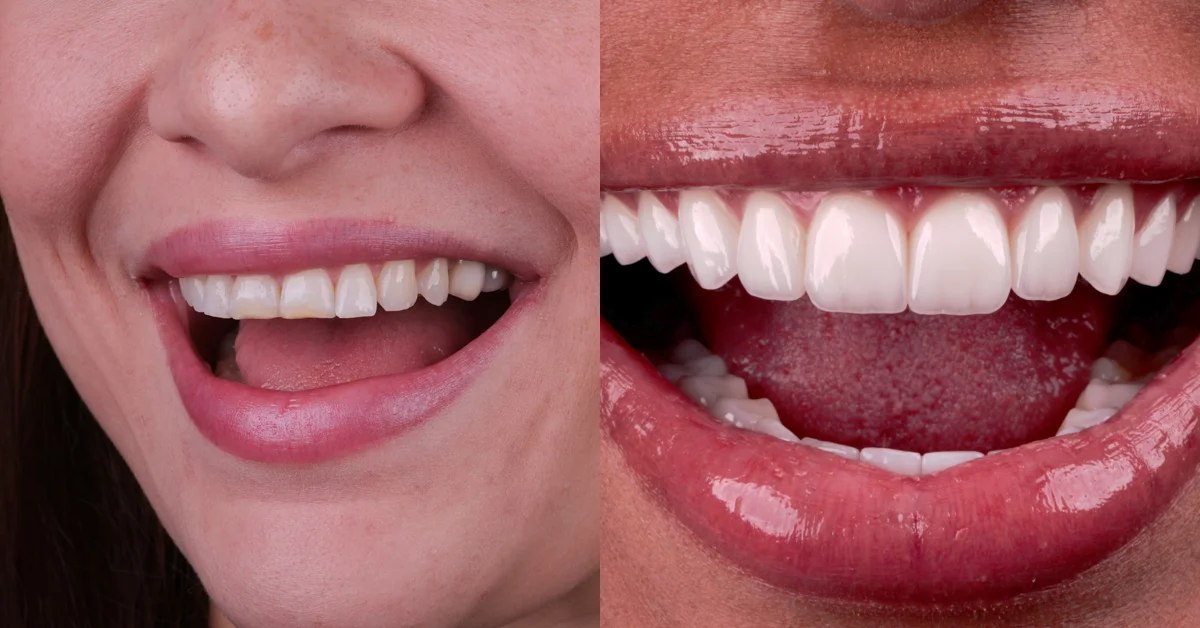
Composite resin and porcelain both deliver beautiful results, but they serve different profiles. Resin is applied chairside, costs less and is finished in one or a few sessions. Porcelain is made in a lab, resists stains better and lasts, on average, twice as long, but costs two to four times more per tooth and requires enamel preparation.
The short answer: if the priority is cost, speed and reversibility, composite resin is usually the pick. If the priority is durability, color stability and top-tier aesthetics, porcelain wins. The clinical case, the patient's budget and their maintenance expectations decide the rest.
Below I break down the comparison I make myself when talking with dentists and patients, and how simulating the result before starting changes that conversation.
What is the practical difference between composite resin and porcelain?
In one sentence: resin is sculpted by hand by the dentist directly on the tooth; porcelain is fabricated in a lab and cemented later.
| Criterion | Composite resin | Porcelain |
|---|---|---|
| Where it is made | Chairside, by the dentist | In the lab, by a dental technician |
| Treatment time | 1 to 2 sessions | 2 to 4 sessions, with lab turnaround |
| Cost per tooth | More affordable | On market average, 2 to 4 times resin |
| Estimated lifespan | About 5 to 7 years | About 10 to 15 years |
| Stain resistance | Absorbs pigments over time | High resistance, stable color |
| Tooth grinding | Often minimal or none | Usually requires enamel preparation |
| Repair | Repairable chairside, no redo | A fracture usually requires a new piece |
When is composite resin the better choice?
Resin makes sense when the patient wants speed, when the budget is tighter, or when the case calls for maximum tooth conservation. Closing small gaps, shape corrections and trial smiles before definitive treatment are situations where it shines.
I learned this in practice, talking with dentists who partner with dentraw LAB: many use resin as a validation stage. The patient lives with the new shape for a while, confirms it is what they want, and only then moves to porcelain. The risk of dissatisfaction drops a lot when that stage exists.
Another point for resin is repair. Chipped, stained, lost its shine: the dentist fixes it chairside without redoing the whole job. For younger patients or anyone still defining their ideal smile, that flexibility carries real weight.
When is porcelain worth the investment?
Porcelain pays for itself when the patient thinks long term. The glassy surface does not absorb pigment like resin, so coffee, wine and tobacco mark it far less. The translucency and texture of ceramic mimic natural enamel with a fidelity that resin, in most clinicians' hands, cannot match.
The higher cost comes from the process: impression or scan, lab fabrication by a dental technician, try-in and cementation. It is work from two chairs: the dentist's and the lab's. When that lab truly masters ceramics, the result often holds for a decade or more with good care.
The trade-off: enamel preparation is, in most cases, irreversible. Once prepared, the tooth will always need some kind of coverage. That is why the resin versus porcelain decision should not be purely financial; it defines the tooth's future.
How do you decide together with the patient?
The script I see working in the clinics I follow at dentraw LAB is this:
- Define the patient's priority: cost, time, durability or maximum aesthetics.
- Assess the tooth: how much healthy enamel exists, any old restorations, stable occlusion.
- Simulate the result before any preparation, to align expectations.
- Present both options with cost and durability ranges, with no promise of outcome.
- If there is doubt, consider resin as an intermediate stage and porcelain as the definitive plan.
In step 3, simulation tools changed the game. With Preview, from dentraw LAB, the dentist shows the patient how the smile could look in minutes, before touching the tooth. From my experience listening to practices, that image settles half of the material doubts, because the patient starts discussing the result they saw, not an abstract promise.
FAQ
Composite resin or porcelain: which lasts longer? Porcelain usually lasts longer, on average 10 to 15 years with good care, while composite resin typically needs maintenance or replacement within 5 to 7 years. Real durability depends on patient habits, technique and case planning.
Does composite resin stain more than porcelain? Yes. Resin absorbs pigments from coffee, wine and tobacco over time and can lose its shine. Porcelain has a glassy surface that resists stains far better, keeping its color for much longer.
Does a resin veneer damage the tooth? When properly indicated and executed, resin is a conservative technique and in many cases requires no grinding at all. Porcelain usually needs some enamel preparation. In both cases, the dentist's evaluation defines what is safe for each tooth.
Which is cheaper: resin or porcelain? Composite resin is far more affordable, done chairside in one or a few sessions. Porcelain involves laboratory work and costs, on market average, two to four times more per tooth, varying by region and lab.
Can you switch from resin to porcelain later? Yes, it is a common path. Many patients start with resin for the speed and cost and move to porcelain when they want a longer-lasting result. The dentist removes the resin and prepares the tooth for ceramic veneers.
If your case is heading toward porcelain, the choice of lab weighs as much as the choice of material. In the dentraw LAB directory you can find partner labs to compare and talk to.
Related articles
Frequently asked questions
Composite resin or porcelain: which lasts longer?
Porcelain usually lasts longer, on average 10 to 15 years with good care, while composite resin typically needs maintenance or replacement within 5 to 7 years. Real durability depends on patient habits, technique and case planning.
Does composite resin stain more than porcelain?
Yes. Resin absorbs pigments from coffee, wine and tobacco over time and can lose its shine. Porcelain has a glassy surface that resists stains far better, keeping its color for much longer.
Does a resin veneer damage the tooth?
When properly indicated and executed, resin is a conservative technique and in many cases requires no grinding at all. Porcelain usually needs some enamel preparation. In both cases, the dentist's evaluation defines what is safe for each tooth.
Which is cheaper: resin or porcelain?
Composite resin is far more affordable, done chairside in one or a few sessions. Porcelain involves laboratory work and costs, on market average, two to four times more per tooth, varying by region and lab.
Can you switch from resin to porcelain later?
Yes, it is a common path. Many patients start with resin for the speed and cost and move to porcelain when they want a longer-lasting result. The dentist removes the resin and prepares the tooth for ceramic veneers.